
There are few pieces of federal legislation more important to children and families than the Farm Bill. Perhaps more appropriately named the Food Bill or the Food and Farm Bill; it is a massive piece of legislation totaling over 800 pages, with policies and programs that extend far beyond farming. The legislation governs how food is produced, aggregated, and distributed in the United States, and determines how well (or poorly) our country supports nutrition and mitigates food insecurity. It defines our government’s perspective on conservation and climate change, also playing a major role in the economic development of rural communities. The bill impacts almost every aspect of our lives—the economy, the climate, and public health.
The Farm Bill is typically reauthorized every five years and has historically been passed in a largely bipartisan manner. Despite its breadth and importance, the last Farm Bill was passed in 2018 and has now been extended multiple times since its initial expiration in September of 2023. The U.S. House of Representatives passed its version of the Farm Bill at the end of April, and the Senate is now working on the legislation.
Here we highlight specific changes in the Farm Bill passed by the House, focusing on provisions relevant to early childhood advocates and Farm to Early Care and Education (ECE) practitioners. These changes are not final law: the Senate must first pass its version of the Farm Bill, the House and Senate must then agree to a common version of the legislation, and then it must be signed by the President. While there is a long way to go in the process, discussing these changes now provides you with the opportunity to engage in the process as advocates to make this incredibly important piece of legislation more supportive of the children and families you serve.
What Early Childhood Education Advocates Should Know
The Farm Bill contains agriculture, nutrition, and food security programs that profoundly impact young children. Title IV includes the country’s largest nutrition program — the Supplemental Nutrition Assistance Program (SNAP). For young children, reliable access to nutritious food is critical to healthy development, and this component of the Farm Bill is extremely relevant to the ECE field. The Farm Bill also funds programs that are important to Farm to ECE practitioners, including the Local Food Promotion Program, the Regional Food System Partnership Program, the Specialty Crop Block Grant Program, and the Gus Schumacher Nutrition Incentive Program (GusNIP). Here is how these programs fared in the House version of the Farm Bill:
Nutrition
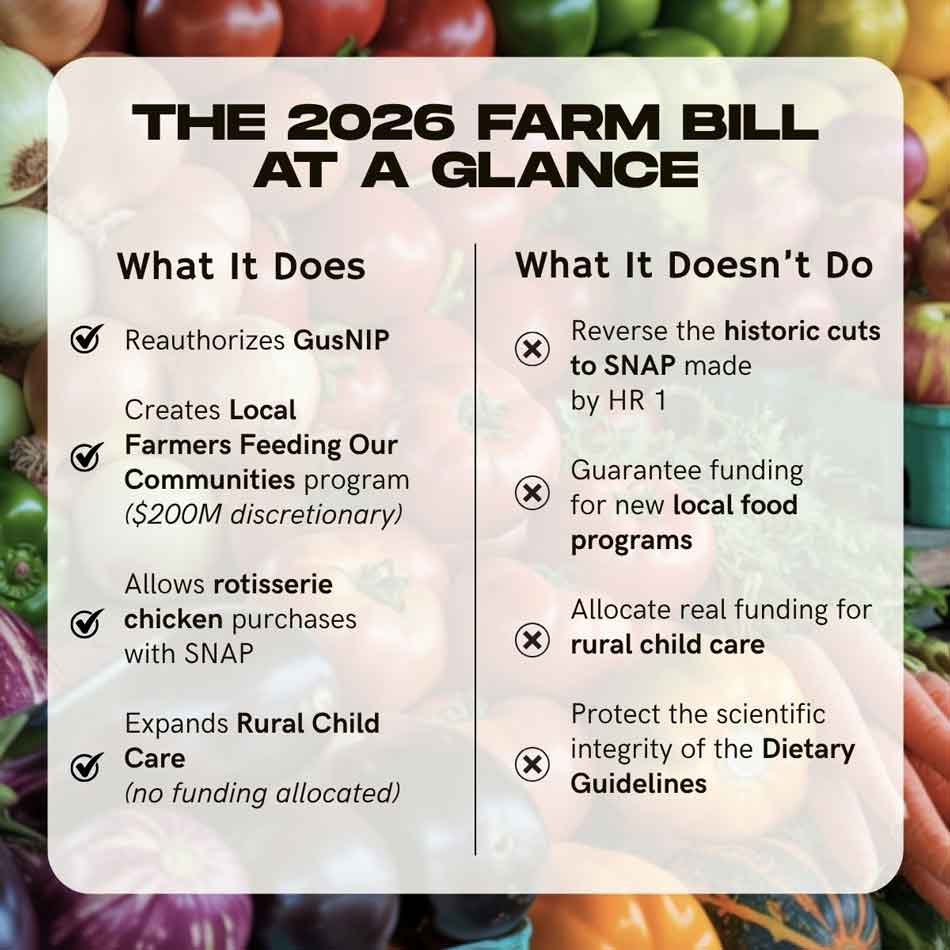
Reaffirms Harmful Cuts to SNAP – The bill makes no effort to reverse the damaging cuts to SNAP made by HR 1 in 2025. Millions have already lost access to food assistance, and the House version of the bill locks in that harm.
Allows for the Purchase of Rotisserie Chicken with SNAP – SNAP recipients would be allowed to purchase rotisserie chicken, which has historically been an arbitrary restriction on a protein-rich, ready-to-eat food item. This is an important change that in no way makes up for the scale of benefit losses families are experiencing.
Reauthorizes and Makes Changes to GusNIP – The bill would allow GusNIP, which supports programs that help families participating in SNAP purchase produce, to waive the federal match requirement for counties with “persistent poverty.” It would expand allowable purchases from “fresh fruits and vegetables,” to “all forms of fruits, vegetables, and legumes,” opening the door for canned and frozen produce. While welcome, these positive changes to GusNIP must be considered within the overall context of the large cuts to SNAP.
Changes to the Development of the Dietary Guidelines – The 2026 Farm Bill would change the review cycle of the Dietary Guidelines from at least every 5 years to at least every 10 years, reducing the responsiveness of new nutritional research and information. It would remove language requiring the Dietary Guidelines to be based on the “preponderance of scientific and medical knowledge” to “scientific agreement” opening the door to undermine scientific integrity and nutrition research. This section would also create an “Independent Advisory Board” to develop the questions that inform the Dietary Guidelines. Half of the members would be appointed by the Secretary, and the other half appointed by members of Congress, carving a path for undue political influence by industry.
New Program for Local Food – The bill would provide $200 million in funding annually for the “Local Farmers Feeding Our Communities” program. This program is similar to the previously cancelled Local Food for Schools program. Funding is discretionary, so Congress does not have to fund it, and the amount does not recover the previous cancellation.
Child Care
Expanding Rural Child Care – The bill would establish the Rural Child Care Initiative within the United States Department of Agriculture to address the availability, quality, and cost of child care in rural areas through loans and grants. However, the bill does not allocate any specific funding for the initiative, creating questions about the potential reach and impact of a new program.
SNAP Cuts and the Farm Bill: The Bigger Picture
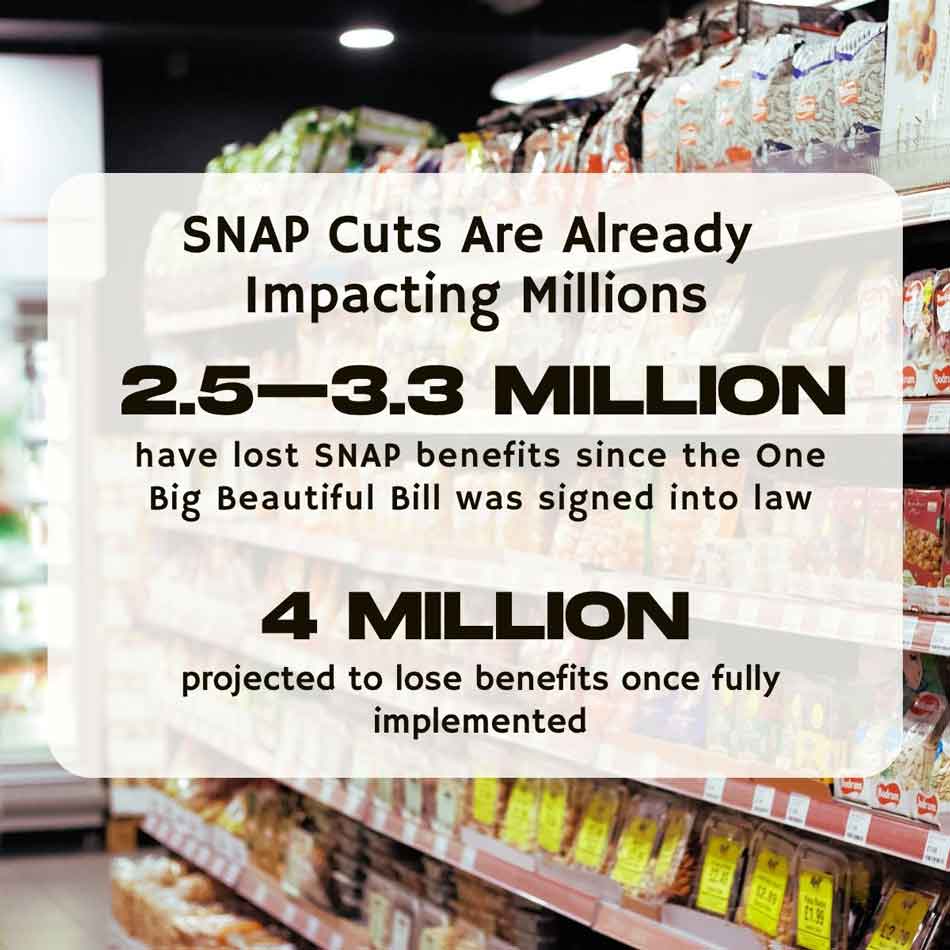
The changes to the Farm Bill noted above must be viewed against the backdrop of massive cuts to programs that support children and families. This includes nearly $1 billion in cuts to local food funding in 2025, as well as HR 1, the reconciliation package that makes historic, damaging changes to SNAP and Medicaid. While the 2026 Farm Bill is being written, 4 million people are likely to lose access to essential food assistance, while another 7 million will no longer have health care coverage under Medicaid. The inclusion of local food funding does little to make up for cuts that will harm millions of people across the country — including those who live in rural areas (the same communities that drive agricultural production). In rural communities, where food insecurity rates are higher than the national average, these cuts will shape the long-term health of families and the development of children.
Families who lose access to SNAP are left to decide between paying for food, rent, utilities, and other bills. The stress of financial strain increases risks for preventable health problems, like heart disease and high blood pressure. Children who grow up without reliable access to food also face lasting consequences. For many children in this country, meals at school or in an ECE program are often more nutritious and reliable. While HR 1 didn’t make direct changes to child nutrition programs like school lunches or the Child and Adult Care Food Program (CACFP), cuts to SNAP threaten the viability and reach of these programs.
What ECE Advocates Should Watch in 2026
The path forward for the Farm Bill remains uncertain. If it fails to pass, Congress will likely continue to extend the 2018 version. With both chambers narrowly controlled by Republicans and midterm elections approaching in November, if the 2026 Farm Bill isn’t passed this year, its contents could easily shift depending on what changes after Election Day.
It is also important to note that the Farm Bill is not the only legislative vehicle that matters. The Child Nutrition Reauthorization (CNR) — last passed as the Healthy, Hunger-Free Kids Act of 2010 and has been due for reauthorization since 2015 — is equally important to child nutrition and Farm to ECE.
What You Can Do as a Farm to ECE Advocate
Stay informed and get engaged. Follow organizations like the Food Research & Action Center and the National Sustainable Agriculture Coalition for regular updates on the Farm Bill and SNAP. Pay attention to the calls to action from these organizations and participate in the legislative process when they call upon you.
Become an advocate for state and local action. When federal policy falls short, state and local governments can step up. Advocate for policies at the state and local level that will benefit kids, families, ECE providers, and farmers.
The Bottom Line for Farm to ECE Advocates
Farm to ECE is the merging of two complicated, flawed, and challenging systems — food and ECE. Both systems are marked by low wages, high turnover, and issues that are localized and unique. We know that small farms are suffering, that families are struggling with rising food costs, that child care remains inaccessible and unaffordable, and that nutrition and food access play a critical role in a young child’s development. When efforts at the federal level fail, we can look to our state and local governments to create or build upon existing policies that will benefit kids, families, ECE providers, farmers, and our communities at large.